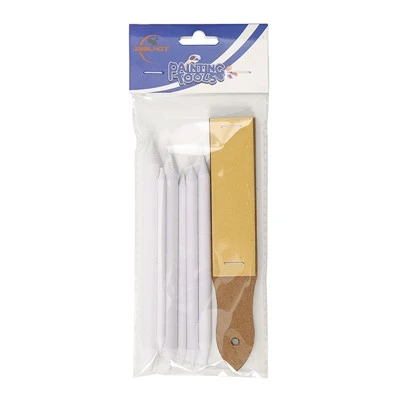
What are the limitations of using blending stumps in practice?
Leave a message

As a supplier of blending stumps, I've witnessed firsthand the widespread popularity of these tools among artists, from beginners honing their skills to seasoned professionals perfecting their masterpieces. Blending stumps are invaluable for creating smooth, seamless transitions in drawings, smudging graphite or charcoal, and adding depth and dimension to artworks. However, like any artistic instrument, blending stumps come with their own set of limitations that artists should be aware of when incorporating them into their practice.
1. Limited Color Blending
One of the primary limitations of blending stumps is their effectiveness in blending colors, particularly when working with mediums other than graphite or charcoal. While blending stumps excel at smudging and blending monochromatic tones, they struggle to achieve the same level of precision and smoothness with colored pencils, pastels, or ink. Unlike dedicated color - blending tools, such as tortillons specifically designed for colored media, blending stumps can leave a muddy or uneven appearance when used to blend colors. This is because the fibers of the blending stump tend to absorb and mix the colors in a less controlled manner, resulting in a loss of vibrancy and clarity.


For example, when using a blending stump to blend colored pencils, the fibers may pick up and transfer excess pigment, creating a streaky or blotchy effect. Additionally, the pressure applied during blending can cause the pigment to smear and become muddled, making it difficult to achieve the desired color gradients and transitions. To overcome this limitation, artists often need to supplement their blending stumps with other color - specific tools or techniques, such as using a colorless blender or facial tissue to blend colored pencils more gently.
2. Tainting of Media
Another significant limitation of blending stumps is the potential for cross - contamination and tainting of drawing media. As blending stumps are used repeatedly to blend different areas of a drawing, the fibers of the stump can accumulate pigment, graphite, or charcoal from previous uses. When the same stump is then used to blend a different area or color, it can transfer this residual media, resulting in unwanted color mixing or smudging.
This issue is particularly problematic when working on detailed or multi - colored drawings, where maintaining the purity of each color is essential. For instance, if a blending stump has been used to blend a dark charcoal area and is then used to blend a light - colored graphite section, the dark charcoal particles can transfer onto the light area, creating a dirty or discolored appearance. To minimize the risk of tainting, artists need to regularly clean or replace their blending stumps. However, cleaning blending stumps can be a time - consuming process, and even with proper cleaning, some residual pigment may still remain.
3. Lack of Precision
Blending stumps are relatively large and blunt tools, which can make them less suitable for achieving fine details and precise blending. When working on small or intricate areas of a drawing, the wide tip of a blending stump can be cumbersome and may blend more area than intended, resulting in a loss of definition. For example, when trying to create delicate highlights or shadows in a portrait drawing, the broad surface of a blending stump may over - blend the area, making it difficult to maintain the sharpness and accuracy of the features.
To address the need for precision, artists often turn to smaller, more pointed tools, such as fine - tip tortillons or blending pencils. These tools offer greater control and allow for more targeted blending, making them ideal for detailed work. While some blending stumps can be sharpened to a finer point, as described in Sharpening Blending Stumps, they still may not provide the same level of precision as dedicated fine - tip tools.
4. Wear and Tear
Blending stumps are subject to wear and tear over time, especially with frequent use. The fibers of the stump can become frayed, matted, or compressed, which can affect their ability to blend effectively. As the fibers break down, the stump may lose its ability to pick up and distribute media evenly, resulting in a less smooth and consistent blending effect.
In addition to normal wear and tear, improper handling or storage can also accelerate the deterioration of blending stumps. For example, if a blending stump is stored in a damp or humid environment, the fibers may become moldy or damaged. Similarly, using excessive pressure when blending can cause the fibers to break or become misshapen. To extend the lifespan of blending stumps, artists should handle them with care, store them in a dry and clean place, and avoid using them on rough or abrasive surfaces. However, even with proper care, blending stumps will eventually need to be replaced, which can add to the cost of art supplies.
5. Limited Surface Compatibility
Blending stumps work best on smooth, non - porous surfaces, such as drawing paper or Bristol board. When used on rough or textured surfaces, the fibers of the stump can catch on the surface irregularities, making it difficult to achieve a smooth blending effect. For example, when working on watercolor paper or canvas, the rough texture can cause the blending stump to skip or leave streaks, resulting in an uneven appearance.
Moreover, some surfaces may be too absorbent, causing the media to soak into the paper or canvas rather than being blended on the surface. This can make it challenging to control the blending process and achieve the desired results. In such cases, artists may need to use alternative techniques or tools, such as using a brush or a sponge to blend the media, or choosing a different type of surface that is more compatible with blending stumps.
6. Difficulty in Blending Thick Layers
Blending stumps are designed to work with thin layers of media. When dealing with thick layers of graphite, charcoal, or other drawing materials, blending stumps may struggle to penetrate and blend the media effectively. Thick layers can create a barrier that prevents the fibers of the stump from reaching the underlying layers, resulting in an uneven or incomplete blending.
For instance, if an artist has applied multiple layers of charcoal to create a bold, textured effect and then tries to blend it with a blending stump, the stump may only be able to blend the top layer, leaving the lower layers untouched. To blend thick layers, artists may need to use other methods, such as using a kneaded eraser to lift some of the excess media or using a brush to spread and blend the media more evenly.
Conclusion
Despite these limitations, blending stumps remain a popular and essential tool in the artist's toolkit. They offer a convenient and effective way to create smooth transitions and add depth to drawings. As a blending stumps supplier, I understand the challenges that artists face when using these tools, and I'm committed to providing high - quality products that minimize these limitations.
If you're an artist looking for reliable blending stumps or want to explore different options, we invite you to visit our website to learn more about our Blending Stump For Drawing and Sketching Stump. We also welcome you to contact us to discuss your specific needs and requirements. Whether you're a professional artist or just starting out, we're here to help you find the perfect blending stumps for your creative projects. Let's work together to overcome the limitations and achieve your artistic vision.
References
- Smith, J. (2018). The Art of Blending: Techniques for Creating Smooth Transitions. New York: Artistic Press.
- Johnson, A. (2019). Drawing Tools and Their Applications. London: Drawing World Publishing.
- Brown, M. (2020). Mastering the Use of Blending Stumps. Paris: Artistic Techniques Journal.