How does blending stumps perform on small datasets?
Leave a message

Hey there, fellow artists and art enthusiasts! I'm a supplier of blending stumps, and today, I wanna talk about how blending stumps perform on small datasets. Now, you might be scratching your head and thinking, "What the heck does blending stumps have to do with datasets?" Well, bear with me, and I'll explain.
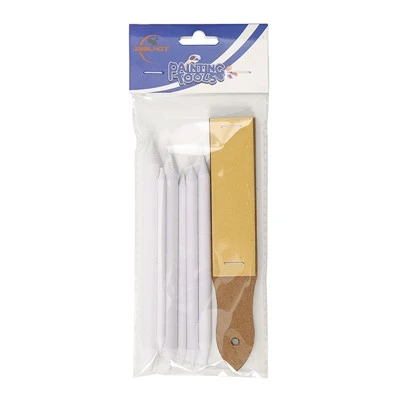
First off, let's get clear on what blending stumps are. A Blending Stump For Drawing is a simple yet incredibly useful tool in the world of art. It's usually made of tightly rolled paper or compressed felt, and it's used to blend and smooth out graphite, charcoal, pastels, and other drawing mediums. They come in various shapes and sizes, and they're a staple in many artists' toolkits.


So, what do I mean by "small datasets" in this context? In art, a "dataset" could be thought of as a limited amount of materials, time, or a specific set of techniques you're working with. For example, you might have a small piece of paper, a limited number of drawing tools, or a short time frame to complete a sketch. Working with these limitations is like working with a small dataset, and blending stumps can play a crucial role in making the most of it.
Advantages of Blending Stumps on Small Datasets
One of the biggest advantages of using blending stumps on small datasets is their ability to create smooth transitions. When you're working on a small area, it can be challenging to blend colors or tones evenly. But a blending stump can help you achieve that seamless look. For instance, if you're sketching a portrait on a small piece of paper, you can use a Sketching Stump to blend the shadows under the eyes or along the jawline. This gives the drawing a more realistic and professional appearance, even with limited space.
Another benefit is that blending stumps are very versatile. You can use them to lighten, darken, or blend different areas of your drawing. This flexibility is especially useful when you're working with a small dataset. Say you're using a single piece of charcoal to create a still - life sketch. With a blending stump, you can turn a simple line drawing into a more complex and textured piece. You can use it to blend the charcoal into a soft background or to emphasize the highlights on an object.
Blending stumps are also great for adding depth to your drawings. On a small piece of paper, it can be hard to convey a sense of three - dimensionality. But by using a blending stump to create gradual changes in tone, you can make objects look more rounded and real. For example, if you're drawing a sphere, you can use the stump to blend the charcoal from the darkest part of the shadow to the lightest highlight. This gives the illusion of a spherical shape, even in a small space.
Challenges and How to Overcome Them
Of course, working with blending stumps on small datasets isn't without its challenges. One common problem is over - blending. Since you're working in a small area, it's easy to go overboard and lose the details of your drawing. To avoid this, you need to be very precise with your blending. Start with light strokes and gradually build up the blend. You can also use a smaller blending stump for more detailed work.
Another challenge is keeping the blending stump clean. When you're working with a small dataset, you might not have a lot of extra materials to clean your stump. But it's important to keep it clean to avoid smudging unwanted areas of your drawing. You can clean your blending stump by gently rubbing it on a clean piece of paper or using a stump sharpener. Sharpening Blending Stumps not only keeps them clean but also gives you a fresh tip for more precise blending.
Tips for Using Blending Stumps on Small Datasets
Here are some tips to help you get the most out of your blending stumps when working with small datasets:
- Choose the right size: Select a blending stump that's appropriate for the size of your drawing. A smaller stump is better for detailed work on a small piece of paper, while a larger one can be used for broader blending on a slightly bigger area.
- Start with a light touch: As I mentioned earlier, it's easy to over - blend on a small dataset. So, start with light strokes and gradually increase the pressure as needed.
- Experiment with different techniques: Don't be afraid to try different ways of using the blending stump. You can use it to create different textures, such as smooth, rough, or grainy. For example, you can roll the stump on the paper to create a grainy texture, or use it in a circular motion for a smooth blend.
- Keep your tools organized: Since you're working with a limited number of materials, it's important to keep everything organized. This will help you work more efficiently and avoid making mistakes.
Case Studies
Let's look at a couple of case studies to see how blending stumps perform on small datasets in real - world scenarios.
Case Study 1: A Quick Portrait Sketch
An artist was given only 15 minutes to sketch a portrait on a 4x6 inch piece of paper. The artist used a single graphite pencil and a small blending stump. By using the blending stump to quickly blend the shadows and highlights, the artist was able to create a realistic portrait within the limited time frame. The blending stump helped to smooth out the lines and add depth to the face, making the portrait look more professional than a simple line drawing.
Case Study 2: A Miniature Still - Life
Another artist was working on a miniature still - life painting on a 3x3 inch canvas. The artist used pastels and a tiny blending stump. The stump was used to blend the different colors of the pastels, creating a harmonious and realistic look. The artist was able to add details and depth to the small painting, making it look more like a full - sized work of art.
Conclusion
In conclusion, blending stumps are an amazing tool when it comes to working with small datasets in art. They offer many advantages, such as creating smooth transitions, adding depth, and being versatile. While there are some challenges, like over - blending and keeping the stump clean, these can be easily overcome with the right techniques.
If you're an artist looking to make the most of your small datasets, I highly recommend giving blending stumps a try. Whether you're a beginner or a professional, these tools can take your drawings to the next level.
If you're interested in purchasing high - quality blending stumps for your art projects, I'd love to have a chat with you. We have a wide range of blending stumps to suit your needs, from different sizes to various materials. Reach out to me, and we can discuss your requirements and find the perfect blending stumps for your next masterpiece.
References
- "The Complete Guide to Drawing Tools" by Artisan Press
- "Techniques for Small - Scale Art" by Creative Arts Magazine
- "Mastering Blending in Drawing" by Professional Artists' Journal