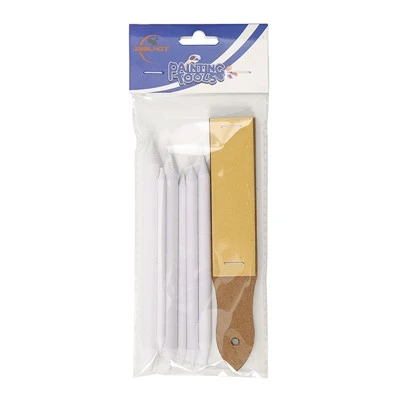
Can I make pottery without using pottery clay tools?
Leave a message

Can I make pottery without using pottery clay tools? This is a question that often pops up among enthusiasts who are either just starting out or looking to explore alternative ways of creating pottery. As a supplier of pottery clay tools, I'm well - versed in this topic and can offer some insights.
First, let's understand the traditional role of pottery clay tools. Pottery clay tools are designed to help potters shape, smooth, carve, and finish their clay creations. There are various types of tools, each with a specific function. For example, Best Pottery Tools for Beginners typically include items like a potter's wheel, which is essential for creating symmetrical vessels. A set of rib tools helps in smoothing the clay surface, while a wire cutter is used to separate the finished piece from the wheel.
However, it is indeed possible to make pottery without using traditional pottery clay tools, but it comes with its own set of challenges and limitations.
Hand - building Techniques without Tools
One of the most basic ways to make pottery without tools is through hand - building. Hand - building techniques have been used for thousands of years and rely on the natural dexterity of the hands. The pinch pot method is perhaps the simplest. All you need is a ball of clay. You start by making a small indentation in the center of the ball with your thumb and then gradually pinch the clay between your thumb and fingers to form a wall. By continuously pinching and shaping, you can create various forms, such as bowls or small cups.
Another hand - building technique is coil building. You roll out long, snake - like coils of clay and stack them on top of each other to build up the walls of your pottery. This method allows for more complex shapes and larger pieces. You can join the coils together by scoring the surfaces (using your fingernail or a rough object) and applying a small amount of slip (a liquid mixture of clay and water). The process requires patience and practice to ensure that the coils are evenly joined and the walls are stable.
Using Everyday Objects as Substitutes
If you don't have pottery clay tools, you can turn to everyday objects as substitutes. For example, a plastic butter knife can be used as a substitute for a pottery cutting tool. It can be used to trim excess clay or cut the clay into smaller pieces. A wooden chopstick can serve as a basic carving tool. You can use it to create patterns or details on the surface of your pottery.
A sponge can be used for smoothing the clay surface. Simply dampen the sponge and gently rub it over the clay to remove any rough edges or unevenness. A fork can also be used to create interesting textures on the clay. By pressing the tines of the fork into the clay, you can create a series of parallel lines or a dotted pattern.
The Limitations of Making Pottery without Tools
While it's possible to make pottery without traditional tools, there are several limitations. Precision is one of the main challenges. Pottery clay tools are designed to provide a high level of precision. For example, a professional potter's wheel allows for consistent rotation and speed control, which is crucial for creating perfectly symmetrical pieces. Without a wheel, it's very difficult to achieve the same level of symmetry.
Complexity of designs is also limited. Tools like Pottery Sculpting Tools are specifically designed to create intricate details and complex shapes. Without these tools, it's challenging to create highly detailed sculptures or pieces with fine - tuned features.


Durability can also be an issue. Properly using tools ensures that the clay is evenly compressed and shaped, which contributes to the overall strength of the pottery. When making pottery without tools, there may be areas where the clay is not properly compacted, leading to weaker spots that are more prone to cracking or breaking during the drying and firing process.
The Benefits of Using Pottery Clay Tools
Using pottery clay tools offers numerous benefits. Firstly, it saves time. Tools are designed to perform specific tasks quickly and efficiently. For example, a pottery rib can smooth a large area of clay in a fraction of the time it would take to do it by hand.
Secondly, it allows for greater creativity. With a wide range of tools available, such as Metal Clay Tools, potters can explore different techniques and create unique designs. These tools can help in creating textures, adding details, and shaping the clay in ways that are not possible with just hands or everyday objects.
Finally, using tools improves the quality of the final product. Tools ensure that the clay is shaped and finished to a high standard, resulting in more durable and aesthetically pleasing pottery.
Why Choose Our Pottery Clay Tools
As a supplier of pottery clay tools, we understand the importance of providing high - quality products. Our tools are made from the best materials, ensuring durability and long - term use. We offer a wide range of tools suitable for beginners as well as professional potters. Whether you're looking for basic hand - held tools or more specialized equipment, we have you covered.
Our Best Pottery Tools for Beginners are carefully selected to provide an easy - to - use and comprehensive set for those just starting out. They are designed to help you learn the basic techniques and build your skills gradually. For more experienced potters, our Pottery Sculpting Tools and Metal Clay Tools offer the precision and versatility needed to create complex and detailed pieces.
Contact Us for Procurement
If you're interested in purchasing pottery clay tools, we invite you to contact us for procurement. We offer competitive prices, excellent customer service, and fast delivery. Whether you're a hobbyist or a professional potter, our tools can take your pottery - making experience to the next level. Don't let the lack of proper tools limit your creativity. Reach out to us and explore our range of high - quality pottery clay tools.
References
- “The Complete Book of Pottery” by Harold Davis.
- “Pottery: A Step - by - Step Guide” by Jenny Clegg.