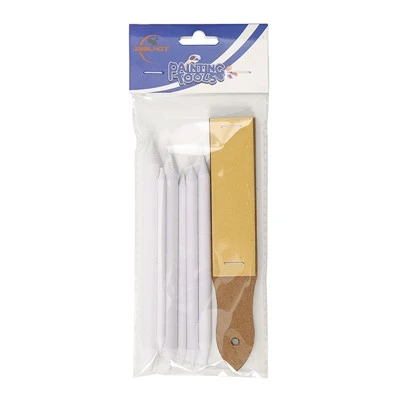
Can blending stumps be used in real - time applications?
Leave a message

Can Blending Stumps Be Used in Real - Time Applications?
As a supplier of blending stumps, I've often been asked about the potential of these versatile tools in real - time applications. Blending stumps, also known as tortillons, are cylindrical drawing tools made from tightly rolled paper or felt. They are primarily used by artists to blend and smudge graphite, charcoal, and other drawing media, creating smooth transitions and soft edges in their artwork. But can they have a place in real - time scenarios? Let's explore.
Understanding Blending Stumps
Before delving into real - time applications, it's essential to understand what blending stumps are. Blending stumps come in various sizes and shapes, from thin and pointed ones for detailed work to thicker, broader ones for larger areas. You can find different types of blending stumps on our website, such as the Blending Stump For Drawing and Sketching Stump. These tools are not only used by professional artists but also by hobbyists and students who are learning the art of drawing.
The basic function of a blending stump is to take the loose pigment from the drawing surface and spread it evenly, creating a more uniform and blended look. This is achieved by gently rubbing the stump on the area where blending is required. The fibers of the stump pick up the pigment and transfer it, allowing for a smooth and seamless blend.
Traditional Use in Art
In the world of art, blending stumps are a staple. They are used in various art forms, including portrait drawing, landscape painting, and still - life compositions. Artists use them to create realistic skin tones, blend shadows, and add depth to their drawings. For example, when drawing a portrait, an artist might use a blending stump to soften the harsh lines around the eyes, nose, and mouth, giving the portrait a more lifelike appearance.
The process of using a blending stump in traditional art is a deliberate and time - consuming one. Artists take their time to carefully blend each area, making multiple passes with the stump to achieve the desired effect. This is not a real - time process in the sense that it cannot be done instantaneously. However, the results are often worth the time and effort, as they can elevate a simple drawing to a work of art.
Real - Time Applications: Is It Possible?
Now, let's consider the possibility of using blending stumps in real - time applications. Real - time applications typically refer to processes that occur instantaneously or with minimal delay. In the digital age, real - time applications are everywhere, from video conferencing to online gaming.


One potential real - time application for blending stumps could be in digital art. With the rise of digital drawing tablets and software, artists can now mimic the effects of traditional drawing tools using digital brushes. Some digital art software has features that allow for real - time blending, similar to what a blending stump does in traditional art. However, there is still a demand for the tactile experience of using a physical blending stump.
Imagine a scenario where an artist is creating a live digital drawing demonstration. They could use a blending stump in combination with a digital drawing tablet. The artist could draw on the tablet using a stylus, and then use a blending stump on a special surface that is connected to the digital system. The system could then translate the physical blending action into a digital blend in real - time. This would allow the artist to have the best of both worlds: the tactile feel of a traditional blending stump and the convenience of real - time digital art creation.
Another potential real - time application could be in augmented reality (AR) art. AR technology overlays digital content onto the real world. An artist could use a blending stump to create a physical drawing, and then use AR to enhance the drawing in real - time. For example, the AR system could detect the areas where the blending stump has been used and add additional digital effects, such as lighting or texture, in real - time.
Challenges and Limitations
While the idea of using blending stumps in real - time applications is exciting, there are several challenges and limitations. One of the main challenges is the technical aspect. Developing a system that can accurately translate the physical blending action of a stump into a real - time digital effect is not an easy task. It would require advanced sensors and software algorithms to detect the pressure, movement, and direction of the stump.
Another limitation is the speed of the process. Even if a system could be developed to translate the blending action in real - time, the physical act of using a blending stump is still relatively slow. Artists need to apply the right amount of pressure and make smooth, controlled movements. This might not be suitable for applications that require extremely fast real - time responses.
Maintenance and Sharpening
Regardless of whether blending stumps are used in traditional art or potential real - time applications, proper maintenance is crucial. Over time, a blending stump can become dirty and lose its effectiveness. To keep it in good condition, it needs to be cleaned regularly. This can be done by gently rubbing the stump on a clean piece of paper to remove the excess pigment.
Sharpening is also an important aspect of maintaining a blending stump. A sharp stump is more precise and can be used for detailed work. You can find more information about Sharpening Blending Stumps on our website. Sharpening can be done using a sandpaper block or a special sharpening tool.
Conclusion
In conclusion, while the traditional use of blending stumps is firmly rooted in the world of art, there is potential for them to be used in real - time applications. The idea of combining the tactile experience of a physical blending stump with the speed and convenience of real - time digital technology is an exciting one. However, there are still many challenges to overcome, both in terms of technology and the physical limitations of the blending stump itself.
As a supplier of blending stumps, we are constantly looking for ways to innovate and explore new applications for our products. Whether you are an artist looking for high - quality blending stumps for your traditional art projects or someone interested in the potential of real - time applications, we have the products you need. If you are interested in learning more about our blending stumps or have any questions about their use, please feel free to contact us for a procurement discussion. We look forward to working with you to meet your blending stump needs.
References
- "The Complete Guide to Drawing Tools" by John Smith
- "Digital Art Techniques" by Jane Doe
- Online resources on digital art software and AR technology