What is the computational complexity of blending stumps?
Leave a message

Hey there, fellow artists and art enthusiasts! I'm a supplier of blending stumps, and I've been getting a lot of questions lately about the computational complexity of blending stumps. Now, I know what you're thinking - "Computational complexity? What does that have to do with blending stumps?" Well, stick around, and I'll explain it all.
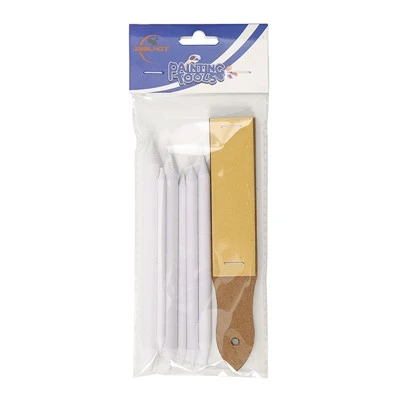
First off, let's talk about what blending stumps are. If you're into drawing or painting, you've probably used them. Blending stumps are these handy little tools made of compressed paper or felt. They're used to blend and smooth out graphite, charcoal, pastels, and other drawing media. You can create some really cool effects, like soft gradients and smooth transitions, with them. For example, check out this Sketching Stump that's great for detailed work.
Now, onto the computational complexity part. At first glance, it might seem like there's no connection between blending stumps and computational complexity. Computational complexity is all about how hard it is for a computer to solve a problem, usually measured in terms of time and resources. But when you think about it, there are some interesting parallels.
Let's say you're an artist working on a large - scale drawing. You've got different areas of the drawing that need different levels of blending. Just like a computer algorithm has to decide the most efficient way to solve a problem, you as an artist have to decide the most efficient way to use your blending stumps.
For instance, if you have a large area that needs a smooth, even blend, you might start with a bigger blending stump. It's like using a more general - purpose algorithm that can quickly cover a large part of the problem. But if you have a small, detailed area, you'd switch to a smaller, more precise blending stump, just like a computer would use a specialized sub - algorithm for a specific part of the problem.
The process of choosing the right blending stump for the job is a bit like the complexity analysis of an algorithm. You have to consider factors like the size of the area, the type of medium you're using, and the desired effect. If you're working with charcoal, you might need a different type of blending stump than if you're working with graphite. It's similar to how a computer algorithm has to be adjusted based on the input data.
Another aspect is the number of steps involved. In computational complexity, we talk about the number of operations an algorithm has to perform. When you're using blending stumps, the number of times you have to blend, the pressure you apply, and the direction of the blending all matter. Just like a complex algorithm might have many nested loops and conditional statements, your blending process can have multiple steps and decisions.
Let's break it down further. Imagine you're creating a portrait. The skin tones need a very smooth blend to look realistic. You might start by using a medium - sized blending stump to rough out the general areas of light and shadow. Then, you'd use a smaller blending stump to refine the details around the eyes, nose, and mouth. Finally, you might use a very fine - tipped blending stump to add the last touches, like the highlights on the cheekbones.


This multi - step process has its own kind of complexity. You have to keep track of what you've already blended, what still needs work, and how to transition between different areas. It's not unlike a computer program that has to manage different data structures and variables as it progresses through a problem.
Now, let's talk about the efficiency of using blending stumps. In computational complexity, efficiency is a big deal. We want algorithms that can solve problems quickly and with minimal resources. As an artist, you want to use your blending stumps in the most efficient way possible.
If you're constantly switching between different blending stumps without a plan, you're going to waste time and energy. Just like an inefficient algorithm that keeps repeating the same calculations, you'll end up with a less - than - optimal result. On the other hand, if you plan your blending process carefully, you can achieve a great result in less time.
Let's look at some real - world examples. Suppose you're working on a landscape drawing. You have a large sky area that needs a soft, hazy blend. You could use a big, fluffy blending stump to quickly cover the area. But if you use a small blending stump for this large area, you'll be spending a lot of time and effort, and the result might not be as smooth.
For the trees and rocks in the landscape, you'll need more detailed blending. A medium - sized blending stump might be a good choice here. And for the fine details like the leaves on the trees, you'd switch to a small, pointed blending stump. By making these smart choices, you're optimizing your blending process, just like a computer optimizes its algorithms.
It's also important to take care of your blending stumps. Just like a computer needs to maintain its hardware and software to work efficiently, you need to keep your blending stumps in good condition. You can sharpen them when they get dull, and here's a great resource on Sharpening Blending Stumps. A sharp blending stump can work more effectively, just like a well - maintained computer can run algorithms faster.
As a blending stumps supplier, I've seen how different artists approach the use of these tools. Some artists are very methodical, carefully planning out their blending process from start to finish. They're like the programmers who write highly optimized algorithms. Other artists are more intuitive, relying on their instincts to choose the right blending stump at the right time. It's a bit like the difference between a well - structured, pre - planned algorithm and a more heuristic - based approach.
So, what's the overall computational complexity of blending stumps? It's hard to put an exact number on it, just like it's hard to give a single complexity measure for all types of algorithms. But it's clear that there's a lot of decision - making, planning, and optimization involved, just like in the world of computational complexity.
Whether you're a professional artist or just starting out, understanding these parallels can help you use your blending stumps more effectively. It can also give you a new perspective on the art of blending.
If you're interested in exploring more about blending stumps, check out our Blending Stump For Drawing. We have a wide range of blending stumps to suit different needs and budgets.
If you're in the market for high - quality blending stumps, I'd love to talk to you. Whether you're an individual artist, an art school, or a professional studio, we can provide the right products for you. Get in touch to discuss your requirements, and let's work together to take your art to the next level.
References
- General knowledge of computational complexity theory
- Personal experience as a blending stumps supplier and observations of artists' practices